0
0

Presented by



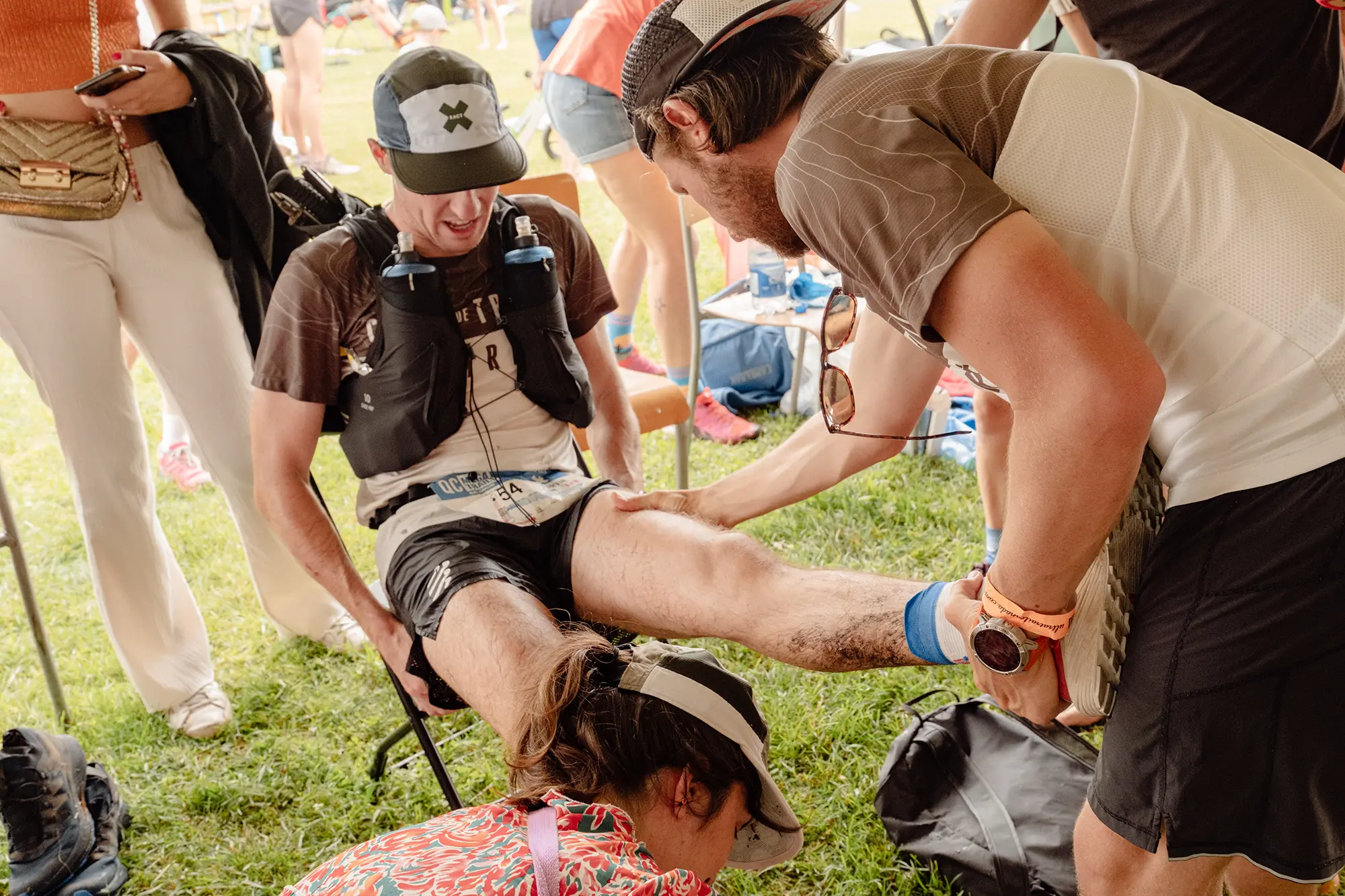
Trail running places significant demands on the body. Between elevation gain and loss, long hours on your feet, technical terrain, and both mental and physical fatigue, runners are exposed to various forms of discomfort throughout a race.
Why do these discomforts occur? What can help the body better tolerate the demands of trail running?
That’s exactly what the PCN team will help demystify in this article!
In trail running, injuries are often related to one of two factors: the overall load placed on the body, which creates significant muscular fatigue, or trauma caused by uneven and technical terrain.
Muscle soreness, particularly in the quadriceps and calves, is very common after long efforts, especially on courses with substantial elevation gain and loss. Knee discomfort is also frequently reported by trail runners, particularly during prolonged descents where impact forces are greater and stabilizing muscles must work hard to control movement.
This is one reason why certain knee injuries are commonly seen among trail runners. A good example is iliotibial band syndrome (ITBS), a painful irritation on the outside of the knee often associated with repetitive movements and downhill running on rolling terrain.
Traumatic injuries caused by missteps, falls, or awkward landings on roots and rocks are also common. Ankle sprains, for example, are frequently observed during trail races.
Blisters, foot irritation, and general muscular fatigue are also common, particularly during longer-distance events.
In many cases, discomfort and injuries are not caused by a single factor but rather by the accumulation of several: a rapid increase in training volume, insufficient adaptation to elevation, inadequate recovery, or accumulated fatigue.
Trail running constantly challenges the body to adapt its stride to changing terrain. The more gradual the preparation, the better the body develops its ability to tolerate these demands.
Trail running stresses the body differently than road running.
First, elevation changes significantly increase muscular demands, especially during descents where muscles must work hard to control movement. Uneven surfaces also require greater stability and control, placing additional demands on the stabilizing muscles of the ankles and hips.
Variable terrain and uneven footing play a major role as well. Unlike road running, where every stride is relatively similar, trails require constant adjustments in stride mechanics, ankle positioning, and balance. These continuous adaptations can become demanding on muscles and joints, particularly as fatigue sets in.
Added to this is the sheer amount of time spent on your feet. Even at moderate intensity, long hours of running can create muscular and mental fatigue that affects technique, coordination, and the body’s ability to absorb impact. As fatigue accumulates, foot placement can become less precise, increasing muscular stress and the risk of missteps on technical terrain.
Trail running also requires the body to produce highly variable efforts. Alternating between climbs, descents, runnable sections, and technical terrain constantly challenges different muscle groups and joints.
It is often this combination of fatigue, elevation, and technical terrain that explains why certain discomforts appear more frequently in trail running.
On race day, certain characteristics frequently stand out among runners who seem to tolerate long distances better and recover more efficiently after an event.
First, their progression is usually gradual. Training weeks are not always perfect, but increases in volume, elevation, and time spent on trails happen progressively. This allows the body to develop its ability to absorb downhill impacts, stabilize joints on technical terrain, and sustain prolonged efforts without accumulating excessive fatigue too quickly.
We also notice that the most consistent runners do not try to make every workout a hard effort. Easier days, quality sleep, and recovery are often integral parts of their preparation. After all, recovery is when the body develops its ability to better tolerate training.
Effort management also plays a major role. Experienced runners are often willing to slow down on climbs, walk strategically when necessary, or adjust their pace according to conditions rather than trying to maintain an unsustainably high effort.
Over time, many runners also develop a better ability to recognize the body’s warning signs. Pain that alters running mechanics, persistent fatigue, or unusual stiffness become signals to pay attention to rather than ignore.
In trail running, consistency and adaptation are often more valuable than the pursuit of a perfect training plan.
Trail running places significant demands on the body. Elevation changes, descents, technical terrain, and long hours of effort create muscular and joint fatigue that is very different from what is typically experienced in road running. If you’re attending QMT, don’t hesitate to stop by and meet the professionals at PCN Physio. They’ll be happy to help you stay healthy, perform at your best, and unlock your full potential.